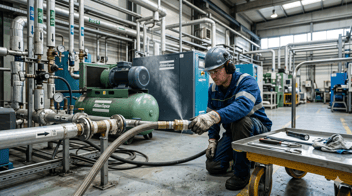
Air leaks are the biggest source of wasted energy in most compressed air systems, and they're easy to ignore. They hiss behind machines, up in ceiling drops, and at quick-connect fittings while your compressor works overtime to keep up. Every leak means wasted electricity, lower pressure at your tools, and a compressor that runs longer and harder than it should.
So how much do air leaks cost? Usually a lot more than plant managers expect. Below, we'll break down leak costs by size, show you how to estimate what your own leaks are costing, and explain how Michigan manufacturers can get leaks fixed with little or no out-of-pocket cost.
Key Takeaways
- A single 1/4" leak can cost more than $16,000 a year in wasted electricity.
- Poorly maintained systems often lose 20% to 30% of their compressed air to leaks.
- A well-maintained system keeps leakage under 10%.
- Utility rebates can cover leak repairs, often with no out-of-pocket cost.
Definition: Compressed air leak Any unintended escape of compressed air between your compressor and the point of use, most often through fittings, hoses, couplings, drains, valves, or pipe joints.
How Much Are Air Leaks Costing My Facility?
A single compressed air leak can cost anywhere from about $70 to more than $37,000 a year, depending on its size and your electricity rate. And most facilities don't have just one.
Leaks are one of the most common problems we find on the plant floor. In a system that hasn't been well maintained, it's normal for 20% to 30% of the air your compressor makes to leak out before it's ever used, according to the Compressed Air Challenge's 2026 leak fact sheet. A well-maintained system should lose less than 10%.
Here's what one leak costs, by size:
| Annual Cost of One Compressed Air Leak by Size | |||
|---|---|---|---|
| Leak Diameter | Air Lost (cfm at 100 psig) | Annual Cost at $0.10/kWh | Annual Cost at $0.09/kWh |
| 1/64" | 0.45 | $72 | $65 |
| 1/32" | 1.6 | $258 | $232 |
| 1/16" | 6.5 | $1,046 | $941 |
| 1/8" | 26 | $4,190 | $3,771 |
| 1/4" | 104 | $16,764 | $15,088 |
| 3/8" | 234 | $37,660 | $33,890 |
Note: Costs assume your system stays pressurized 24/7 with an efficient compressor. Michigan industrial electricity rates generally run around 8 to 9 cents per kWh, so the $0.09 column is a good starting point for most of our customers.
Look at the jump between sizes. Doubling a leak's diameter roughly quadruples what it costs you. That's why the "it's just a small hiss" leak near the paint booth deserves more attention than it usually gets.
Our take: If you can hear it, it's costing you at least $500 a year. That's the rule of thumb our leak team uses on the plant floor, and it's a conservative one. Plenty of audible leaks are 1/16" or larger, and that size runs closer to $1,000 a year. A professional evaluation almost always turns up more leaks than you'd find walking the floor yourself.
How Do You Calculate the Cost of an Air Leak?
To estimate what a leak costs, multiply the air it loses (in cfm) by the power it takes to make that air, then by the hours your system stays pressurized and your electricity rate.
Annual leak cost = leak cfm × 0.19 kW per cfm × annual hours × $ per kWh
That 0.19 number comes from a simple rule: a compressor running around 100 psi makes about 4 cfm of air for every horsepower. One horsepower is 0.746 kW, so each cfm takes roughly 0.19 kW to produce.
Here's a quick example. Say you have a 1/8" leak losing 26 cfm, your system stays pressurized around the clock (8,760 hours a year), and you pay $0.09 per kWh:
26 cfm × 0.19 kW × 8,760 hours × $0.09 = about $3,900 a year
Do you shut your compressor down on nights and weekends? Running two shifts, five days a week (about 4,160 hours a year) cuts that same leak's cost roughly in half, to about $1,850. But lots of plants leave their systems pressurized all the time, and leaks don't take breaks.
Now scale that up to your whole system. A 100 hp compressor makes roughly 400 cfm. If 20% of that air is leaking, you're losing 80 cfm and paying for about 15 kW of power nobody uses. Run that 24/7 at $0.09 per kWh, and you're looking at roughly $12,000 a year from a single compressor.
Want a rough read on your own leak rate? If your compressor has load/unload controls, try this on a weekend or between shifts when nothing in the plant is using air. Time how long the compressor runs loaded versus unloaded over a few cycles. If it's loaded 2 minutes out of every 10, you're leaking about 20% of its capacity.
What Hidden Costs Do Air Leaks Create?
Wasted electricity is only part of the bill. Leaks also drop system pressure, make your compressor run and cycle more, and wear out equipment faster. Those costs never show up on your utility statement, but you pay them anyway.
Here's where they come from:
- Lower pressure at your tools. When pressure drops, air tools and pneumatic equipment work less efficiently, and production slows down.
- Higher pressure setpoints. To make up for leaks, someone usually cranks up system pressure. Every extra 2 psi adds about 1% to your compressor's energy use, so the fix makes the problem more expensive.
- More run time and maintenance. A compressor feeding leaks runs longer and cycles more often, so it wears faster and needs service sooner.
- Capacity you don't need. Leaks can make it look like you've outgrown your compressor when you haven't.
Our take: We regularly talk with facilities shopping for a bigger compressor when the real problem is leaks. Fix the leaks first, then size your equipment. You may find you don't need the extra capacity at all, and that's a much cheaper fix than a new machine.
If your energy bills have been creeping up, see "Why Is My Air Compressor Using So Much Power?"
Where Do Compressed Air Leaks Usually Happen?
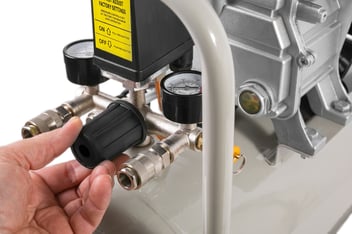
Most compressed air leaks happen at connection points. Couplings, hoses, fittings, pressure regulators, condensate drains, shut-off valves, pipe joints, and quick disconnects are the usual suspects.
The best way to find them is with an ultrasonic leak detector, which picks up the high-pitched hiss a leak makes, even in a loud plant. Brushing soapy water over suspect joints works too, but it's slow going in a large facility.
For a full walkthrough, see our guide on how to find, fix, and prevent air compressor leaks.
Your piping plays a big role too. Older threaded black iron pipe tends to develop leaks at its joints as it ages and corrodes. That's one reason we recommend Infinity™ aluminum piping for new installs and expansions.
And since new leaks show up over time, AIRMATICS™ remote monitoring can help you spot rising air demand before it turns into a big energy bill.
[IMAGE: Diagram of a typical plant compressed air system (compressor, dryer, receiver, distribution piping, drops, hoses, tools) with the most common leak points circled in red]
How Much Do Air Leaks Cost to Fix?
For many Michigan manufacturers, fixing air leaks costs little or nothing out of pocket, because utility energy efficiency rebates can cover the work. Most repairs only need inexpensive parts like fittings, hoses, couplings, or fresh thread sealant, so the savings almost always outweigh the repair cost.
If you're a Consumers Energy electric customer, you've got options. The utility offers compressed air rebates for energy audits and leak repair, along with its Find & Fix® Compressed Air Leaks Program. These programs can cover both prescriptive and custom projects.
The catch? Rebate paperwork takes time, and many facilities never get around to it. That's where the right partner makes all the difference.
| The bottom line: when you work with a supplier who handles utility rebates for you, your leak repairs can be paid for through those rebates, with no out-of-pocket cost to you. |
Not sure where your leaks are? Download the TMI Compressed Air Audit Checklist, or schedule a professional evaluation of your system.
Fix Your Air Leaks and Save Your Money With TMI
We're the only air compressor manufacturer in West Michigan with a dedicated team that specializes in finding and fixing air leaks and handling the utility rebates that pay for the work. We work directly with Consumers Energy, so you don't have to chase down applications or wait on approvals.
How We Fix Air Leaks With No Out-of-Pocket Costs
We confirm your rebate eligibility with the utility before we start, so you'll know what's covered up front. There are no purchase orders or proposals to approve. We get paid from the utility rebates after we submit our report.
| TMI's Leak Repair Process | ||
|---|---|---|
| Step | What We Do | What It Means for You |
| 1. Confirm eligibility | Verify rebate eligibility with your utility | You know the work is covered before we start |
| 2. Find | Survey your system on site for leaks | Leaks get found, including the quiet ones |
| 3. Tag and report | Tag each leak and document it in a report | You get a clear record of what was found |
| 4. Fix | Repair leaks on site | Wasted air and energy stop right away |
| 5. Submit | Send our report to the utility for the rebate | No purchase order, no out-of-pocket cost |
Once the leaks are fixed, it's worth taking a second look at your compressor controls. If your compressor keeps running the same way it did before repairs, you won't see the full drop in your energy bill.
Learn more about choosing the right air compressor control system in our blog, "Air Compressor Controls: How to Choose the Right Control System for Efficiency and Performance."
Contact TMI
Every day a leak goes unfixed, you're paying for air you'll never use. Give us a call or contact us online to schedule a leak evaluation. We'll confirm your rebate eligibility first, so there are no surprises.
Schedule a leak evaluation with TMI. We'll find, tag, and fix your leaks, and handle the rebate paperwork.
Air Leak Cost FAQs
How much does a compressed air leak cost per year?
It depends on the leak's size and your electricity rate. At 100 psig and $0.10 per kWh, a 1/16" leak costs about $1,046 a year, a 1/8" leak costs about $4,190, and a 1/4" leak costs about $16,764. Those numbers assume your system stays pressurized around the clock.
What percentage of compressed air is lost to leaks?
A poorly maintained system can lose 20% to 30% of its compressed air to leaks, and around 20% is common in plants that haven't had a leak survey in a while. A well-maintained system should keep leakage below 10%, which is very doable with a regular detection and repair program.
How do you calculate the cost of a compressed air leak?
Multiply the leak's airflow in cfm by about 0.19 kW per cfm, then by your annual pressurized hours and your electricity rate. For example, a 26 cfm leak running 8,760 hours a year at $0.09 per kWh costs about $3,900 annually. Fewer pressurized hours mean a lower cost.
How do you find compressed air leaks?
The most effective method is an ultrasonic leak detector, which picks up the high-pitched sound of escaping air even in noisy plants. Soapy water brushed onto joints also works but takes much longer. Start with couplings, hoses, fittings, regulators, condensate drains, and pipe joints, since that's where most leaks happen.
Does Consumers Energy offer rebates for compressed air leak repair?
Yes. Consumers Energy offers compressed air rebates for energy audits and leak repair, plus a Find & Fix® Compressed Air Leaks Program for its electric business customers. Working with a supplier that handles the rebate process for you can reduce or completely eliminate your out-of-pocket cost for leak repairs.
How often should you check for compressed air leaks?
Check for leaks at least once a quarter. New leaks show up constantly as hoses wear, fittings loosen, and seals age, so a one-time fix won't hold. The best programs set a target leak rate, tag and track every leak, verify repairs, and get operators involved in reporting leaks they hear.
Do small air leaks really matter?
Yes, because they add up. A single 1/32" leak might only cost a couple hundred dollars a year, but most facilities have many leaks spread across the system. When a typical plant loses around 20% of its compressed air to leaks, those small hisses can easily mean thousands of dollars a year.