Not all industrial blowers work the same way, and picking the wrong one can cost you big in energy bills, downtime, or a system that just can't hit the pressure your process needs.
Industrial blowers move air or gas through a facility for everything from wastewater aeration to pneumatic conveying, but the technology behind that airflow varies a lot from one blower type to the next.
This guide breaks down the five most common types of industrial blowers, how each one works, and where it fits best.
So which of these five is right for your process? Let's find out.
Key Takeaways:
- Five main types of industrial blowers: positive displacement, rotary lobe, side channel, radial, and regenerative blowers.
- Each moves air differently, with real trade-offs in pressure, noise, and efficiency.
- Efficiency should usually outweigh upfront price, since most blowers run continuously.
What Is an Industrial Blower?
An industrial blower is a machine that moves a continuous, high-volume stream of air or gas at low to moderate pressure, using a rotor, lobes, or an impeller instead of a piston or screw. Unlike an air compressor, which stores pressurized air for on-demand use, a blower typically runs around the clock.
Blowers show up anywhere a process needs continuous airflow instead of stored pressure, including wastewater aeration, pneumatic conveying, combustion air, cooling, and vacuum systems.
Why does the type of blower matter so much? Matching pressure, volume, and duty cycle to the job determines whether you get years of reliable performance or a blower that's always working too hard.
|
Wastewater treatment is the single largest end market for industrial blowers, at an estimated $899 million in global revenue in 2025, according to Global Market Insights' 2026 Industrial Blower Market report, largely because aeration blowers keep treatment basins oxygenated around the clock. |
What Are the 5 Main Types of Industrial Blowers?
The five most common types of industrial blowers are positive displacement, rotary lobe, side channel, radial, and regenerative. Each uses a different mechanical principle to move air, which is why one type can be the clear winner for a wastewater aeration basin and the wrong choice for a pneumatic conveying line.
1. Positive Displacement Industrial Blowers
Positive displacement (PD) blowers trap a fixed volume of air with each rotation and push it out the other side, so they deliver consistent airflow no matter how the pressure in your system changes. That makes them a dependable choice for high-volume, high-pressure jobs like combustion air and pneumatic conveying.
PD blowers aren't a great fit for applications that demand very high static pressure, and they run less efficiently than centrifugal designs since they move less air per revolution.
Even so, they still lead the market: positive displacement models held 43.7% of global industrial blower revenue in 2025, about $1.71 billion. That share is projected to slide to 38.5% by 2035 as facilities shift toward higher-efficiency designs, but PD blowers remain hard to beat for rugged, straightforward reliability.
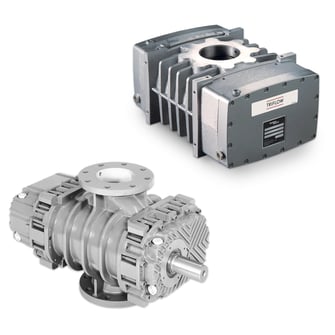
2. Rotary Lobe Industrial Blowers
Rotary lobe blowers are the most efficient style of positive displacement blower. Two-lobed rotors turn in opposite directions to push air from intake to discharge without the lobes ever touching, which keeps lubrication needs low and cuts contamination risk.
The rotating lobes create negative pressure in the discharge chamber that pulls more air in through the intake port, giving rotary lobe blowers high volumetric efficiency at low noise levels. That's why you'll find them running vacuum pumps, gas compression systems, refrigeration heat exchangers, and other pneumatic equipment.
Our Take: Rotary lobe blowers from manufacturers like Gardner Denver are some of the most common blowers we service across Michigan plants. Their simple design results in fewer unplanned failures than more complex blower types.
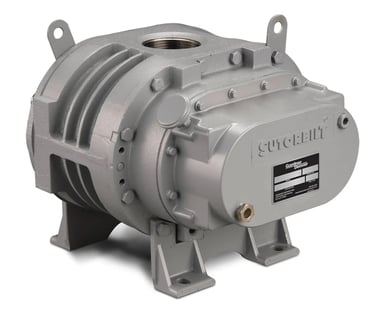
3. Side Channel Industrial Blowers
Side channel blowers use a spinning impeller to create swirling pockets of air inside a curved channel, building pressure gradually instead of trapping and displacing air the way a positive displacement blower does. That gives them higher volumetric efficiency per revolution, plus quieter operation and a lower pressure drop.
The tradeoff is complexity. Side channel blowers rely on internal lubrication instead of an external oil reservoir, which means more moving parts and more scheduled maintenance. They're a strong fit for moderate pressure and volume with low noise, like packaging and pneumatic conveying in food and beverage plants.
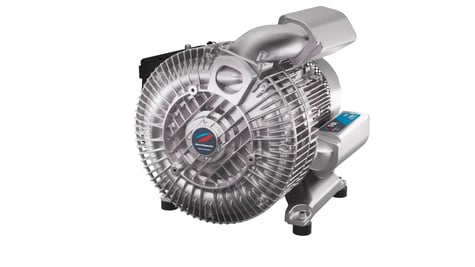
4. Radial Industrial Blowers
Radial blowers, also called centrifugal blowers, use a spinning impeller to fling air outward by centrifugal force, building pressure as air moves from the center of the wheel to its outer edge. That gives them a strong pressure ratio at lower rotational speeds than other blower types, cutting both energy use and noise.
Radial blowers don't need the tight internal clearances PD or side channel models do, so they run with less vibration at higher RPMs, and their compact footprint suits tight mechanical rooms.
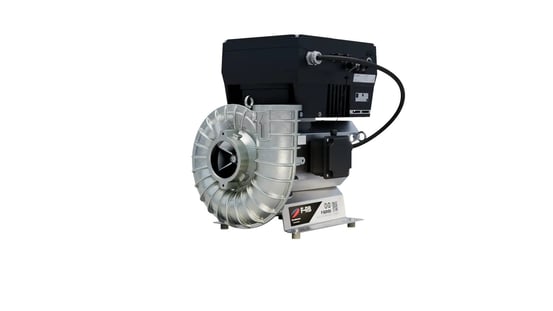
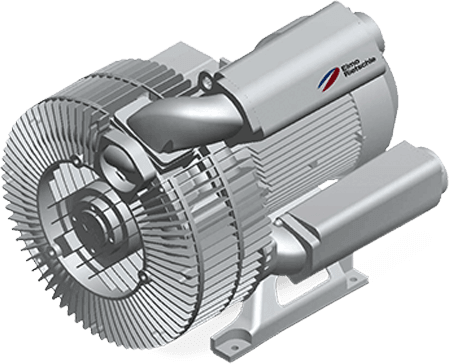
5. High-Performance Regenerative Industrial Blowers
Regenerative blowers repeatedly accelerate air around a rotating impeller inside a circular housing, adding energy with each pass until it reaches the outlet. That action gives them some of the highest efficiency and lowest noise levels of any blower type, which is why they show up in food processing, pharmaceutical, and semiconductor applications that demand clean, high-volume airflow.
Our Take: Regenerative blowers and side channel blowers run on the same underlying principle, and some manufacturers use the terms almost interchangeably. Don't assume a spec sheet using one term over the other means a totally different technology; application and performance range are what really separate one model from the next.
The downside is cost. Like radial blowers, regenerative models carry a higher price tag than simpler positive displacement units, which can put them out of reach for smaller budgets even when they'd be the more efficient long-term choice.
How Do the 5 Blower Types Compare?
Positive displacement and rotary lobe blowers handle high pressure and rugged duty best, side channel and regenerative blowers win on efficiency and noise, and radial blowers split the difference with a compact footprint and a strong pressure ratio at lower speeds.
Here's how the five stack up side by side:
5 Types of Industrial Air Blowers |
|||||
|---|---|---|---|---|---|
|
Blower Type: |
How It Moves Air: |
Pressure Range: |
Relative Efficiency: |
Noise Level: |
Best For: |
|
Positive Displacement |
Traps and displaces a fixed volume of air |
High |
Lower |
Moderate-High |
Combustion air, pneumatic conveying |
|
Rotary Lobe |
Lobed rotors create negative pressure that pulls air through |
High |
Moderate |
Low |
Vacuum pumping, gas compression, refrigeration |
|
Side Channel |
Impeller creates swirling air pockets, building pressure in stages |
Moderate |
Higher |
Low |
Packaging, food & beverage conveying |
|
Radial (Centrifugal) |
Impeller flings air outward by centrifugal force |
Moderate-High |
Higher |
Low-Moderate |
Tight mechanical rooms, general ventilation |
|
Regenerative |
Repeated acceleration around a circular housing |
Moderate |
Highest |
Lowest |
Food processing, pharma, semiconductor |
How Do You Choose the Right Industrial Blower for Your Application?
The right blower for your facility comes down to three questions: how much pressure do you need, how much volume do you need to move, and how many hours a day will it run?
Get those three numbers right, and you'll rule out most of the wrong options before you ever compare brands.
Quick checklist before you buy:
- Pressure range: Do you need high static pressure (positive displacement, rotary lobe) or moderate pressure with higher efficiency (side channel, radial, regenerative)?
- Flow volume: What's your peak CFM requirement, not just your average load?
- Duty cycle: Will it run a few hours a day, or 24/7? Continuous runtime makes efficiency, not price, the deciding factor.
- Noise tolerance: Is it going in an occupied space, or a mechanical room where noise matters less?
- Maintenance capacity: Can your team handle more internal lubrication points (side channel), or do you need something lower-maintenance (rotary lobe)?
- Air quality: Does the application involve moisture, particulates, or corrosive air that rules out certain designs?
- Budget vs. lifetime cost: Is the lowest upfront price worth it if a more efficient model pays for itself in electricity savings?
Runtime matters more than people expect. Centrifugal-style blowers typically run 70-80% efficient, compared to roughly 45-65% for positive displacement models, per blower efficiency data compiled by manufacturer Inovair. In wastewater treatment, aeration blowers alone can account for 25 to as much as 60 percent of a plant's total energy use, per that same EPA report. That's the kind of gap that turns an efficient blower into a fast payback.
Industrial Blowers from TMI Compressed Air Systems
TMI Compressed Air Systems supplies and services industrial blowers from premium brands known for durability and efficiency, backed by industry-leading warranties and our team's 250+ years of collective experience across Michigan manufacturing, food and beverage, pharmaceutical, and plastic injection molding facilities.
We don't just sell a select line of blowers; we service nearly any make and model, so you're not stuck calling around when equipment we didn't supply breaks down.
Request a quote on a new industrial blower or schedule service on your existing system →
Frequently Asked Questions About Industrial Blowers
What's the difference between an industrial blower and an air compressor?
An industrial air blower moves a continuous, high-volume stream of air at low pressure. An air compressor stores pressurized air for on-demand use. Blowers typically run continuously, while compressors cycle on and off. If your process needs steady airflow rather than stored pressure, a blower is the better fit.
Which type of industrial blower is most efficient?
Regenerative and side channel blowers generally deliver the highest efficiency and lowest noise, followed by radial and high-speed turbo models. Positive displacement blowers are reliable and rugged, but run less efficiently since they move less air per revolution than centrifugal-style designs.
What is a rotary lobe blower used for?
Rotary lobe blowers commonly run vacuum pumps, gas compression systems, refrigeration heat exchangers, and other pneumatic equipment. Their lobed rotors create high volumetric efficiency at low noise, and since the lobes never touch, they need minimal internal lubrication.
Are positive displacement blowers still the industry standard?
Yes, for now. PD blowers held 43.7% of the global industrial blower market in 2025, about $1.71 billion in revenue, according to Global Market Insights' 2026 Industrial Blower Market report. That share is expected to decline gradually as centrifugal and turbo blower adoption grows.
How much does an industrial blower cost to run?
The cost to run an industrial blower depends more on horsepower, duty cycle, and efficiency than on purchase price. Since blowers often run continuously, a less efficient model can cost far more in electricity over its lifespan than a higher-efficiency unit costs upfront.
Can TMI service a blower brand it doesn't sell?
Yes. TMI services nearly any industrial blower make and model, not just the brands it sells. With more than 250 years of collective team experience, TMI's technicians support light industrial, food and beverage, pharmaceutical, and plastic injection molding facilities throughout Michigan.