
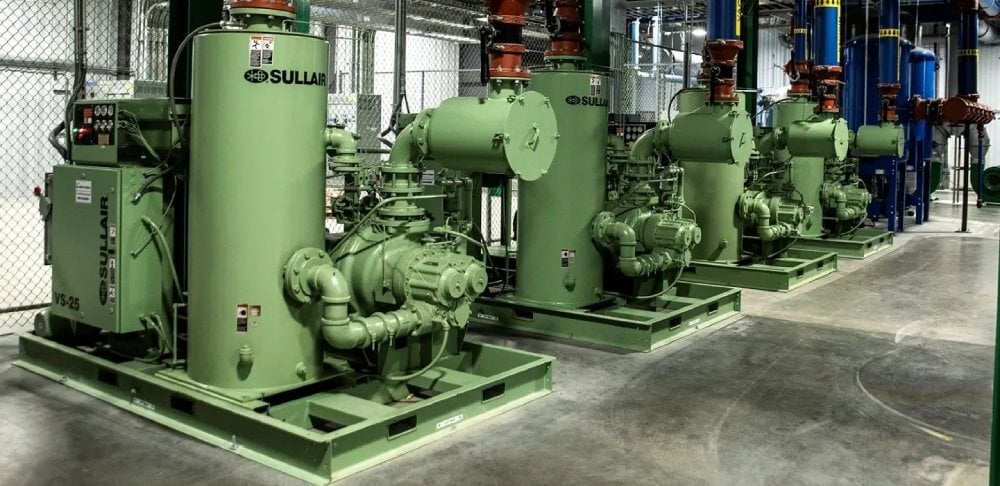
PD blowers and vacuum pumps look a lot alike on a spec sheet. Both use rotating elements to move air, both run for long stretches, and both often come from the same manufacturer. The difference is direction. A positive displacement (PD) blower pushes air into a process at low pressure, while an industrial vacuum system pulls air out of a process to create negative pressure.
That sounds simple, but it's where plenty of plants get tripped up. This guide breaks down how each machine works, where the line between them falls, and which one fits the processes running on your floor.
Key Takeaways:
- PD blowers push air at low pressure. Vacuum pumps pull air out to create negative pressure.
- Most PD blowers top out around 15 to 16" Hg of vacuum. Deeper vacuum calls for a dedicated pump.
- TMI supplies and services Gardner Denver blowers and Elmo Rietschle pumps across West Michigan.
What Is a PD Blower?
A positive displacement (PD) blower is a machine that traps a fixed volume of air with each rotation and moves it from the inlet to the discharge, delivering steady airflow even as system pressure changes. Most industrial PD blowers are rotary lobe designs, meaning three-lobed rotors spin in opposite directions without touching.
Gardner Denver's Sutorbilt line is a good example of what these machines can handle. The Sutorbilt 612-4500 specifications list up to 1,485 CFM of flow, a maximum pressure of 10 psi, and a maximum vacuum of 16" Hg, all rated for continuous industrial duty. That combination of high volume and modest pressure is exactly what processes like aeration and pneumatic conveying need.
PD blowers are still the workhorse of the category. In 2026, Global Market Insights' Industrial Blower Market report found that positive displacement models held 43.7% of global industrial blower revenue in 2025, about $1.71 billion. That share reflects decades of dependable service in wastewater, conveying, and process air applications.
For a closer look at how PD blowers compare to other designs, see our guide to the 5 types of industrial blowers →
What Is an Industrial Vacuum System?
An industrial vacuum system is a pump, or a network of pumps, that removes air or gas from a closed space to create pressure below atmospheric. Plants use that negative pressure to hold parts in place, lift and move products, convey materials, seal packaging, and pull moisture or gas out of a product.
Inches of mercury (" Hg): The most common unit for measuring vacuum in U.S. plants. Atmospheric pressure at sea level equals about 29.92" Hg, so the closer a reading gets to that number, the deeper the vacuum.
Elmo Rietschle builds one of the broadest vacuum lineups in the industry. According to Elmo Rietschle's product FAQ, the company manufactures dry-running and oil-lubricated rotary vane pumps, claw pumps, screw pumps, liquid ring pumps, and side channel blowers, and it has been building vacuum equipment in Germany for more than 70 years.
Browse the full range of pump types we supply on our industrial vacuum pumps page →
What's the Difference Between a PD Blower and a Vacuum Pump?
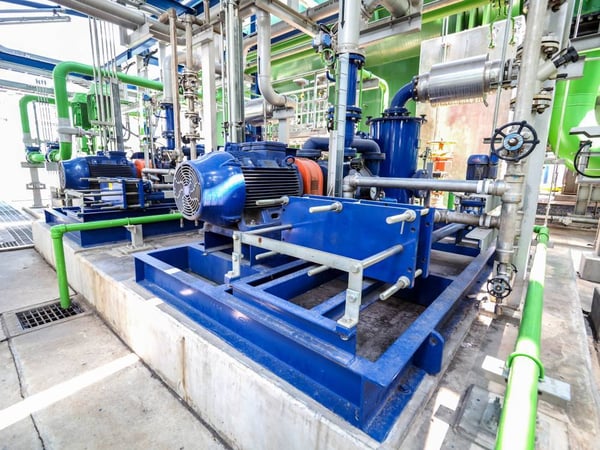
The core difference between the two types of pumps is how deep a vacuum each machine can reach and hold. PD blowers are built to move large volumes of air at low pressure or light vacuum, while vacuum pumps are built to reach and hold deeper vacuum levels, often at lower flow rates.
PD Blower vs. Vacuum Pump Comparison |
||
|---|---|---|
|
PD Blower vs. Vacuum Pump at a Glance |
PD Blower |
Industrial Vacuum Pump |
|
Primary job |
Push air into a process |
Pull air out of a process |
|
Typical range |
Up to about 15 psig pressure or 15 to 16" Hg vacuum |
Moderate to deep vacuum, often 25" Hg and beyond |
|
Flow profile |
Very high volume |
Lower volume at deeper vacuum |
|
Duty cycle |
Continuous |
Continuous or on-demand |
|
Lubrication |
Oil in gear housings; oil-free air path |
Oil-lubricated or dry, depending on type |
|
Common examples |
Aeration, dilute phase conveying |
Hold-down, packaging, degassing |
Here's a quotable way to think about it. A positive displacement blower can serve as a vacuum source for high-flow, low-vacuum jobs like vacuum conveying and dust pickup, but once a process needs more than roughly 15 to 16" Hg, a dedicated vacuum pump such as a rotary vane, claw, or liquid ring design is the better fit.
Our Take: One of the most common issues we see in Michigan plants is a PD blower pushed past its vacuum limit. It'll run, but discharge temperatures climb, the unit works harder than it should, and wear speeds up. If your process keeps asking for "a little more vacuum," that's usually a sign it's time to look at a pump, not a bigger blower.
Which Utility Does Your Process Need?
The right choice depends on whether your process needs pressure or vacuum, how deep that vacuum has to go, and how much air it needs to move. Use the table below as a starting point for matching common plant processes to the right machine.
Recommended Equipment by Plant Process |
|||
|---|---|---|---|
|
Recommended Equipment by Industrial Process |
Pressure or Vacuum |
Recommended Machine |
Example Brand/Line |
|
Wastewater aeration |
Low pressure |
PD rotary lobe or screw blower |
Gardner Denver Sutorbilt, CycloBlower |
|
Pneumatic conveying (pressure) |
Low pressure |
PD rotary lobe blower |
Gardner Denver Sutorbilt, DuroFlow |
|
Pneumatic conveying (vacuum) |
Light to moderate vacuum |
PD blower in vacuum service |
Gardner Denver Sutorbilt, HeliFlow |
|
CNC and router hold-down |
Moderate to deep vacuum, high flow |
Claw or dry rotary vane pump |
Elmo Rietschle claw pumps |
|
Thermoforming and vacuum packaging |
Deep vacuum |
Oil-lubricated rotary vane pump |
Elmo Rietschle oil-lubricated rotary vane |
|
Plastics resin loading |
Moderate vacuum |
Side channel blower or claw pump |
Elmo Rietschle side channel, claw |
|
Vacuum degassing and drying |
Deep vacuum, may carry vapor |
Liquid ring or screw pump |
Elmo Rietschle liquid ring, screw |
|
Pick-and-place material handling |
Moderate vacuum, low flow |
Dry rotary vane pump |
Elmo Rietschle dry rotary vane |
|
Central vacuum for multiple machines |
Varies by load |
Multi-pump central vacuum system |
Elmo Rietschle central systems |
|
Air knife drying and blow-off |
Low pressure, high flow |
Side channel blower |
Elmo Rietschle side channel |
Not sure where your process lands? A quick look at your current vacuum readings, CFM demand, and runtime will usually narrow it down fast.
Talk to a TMI blower and vacuum specialist about sizing equipment for your process.
Gardner Denver vs. Elmo Rietschle: What Does Each Brand Do Best?
Gardner Denver is strongest in pressure and light-vacuum airflow, and Elmo Rietschle is strongest in dedicated vacuum. Both brands now sit under Ingersoll Rand following the 2020 merger, so many plants end up running equipment from both.
Gardner Denver Blowers
Gardner Denver's blower lineup covers straight bi-lobe (Sutorbilt, DuroFlow), straight tri-lobe (TriFlow), twisted tri-lobe (HeliFlow), and helical screw (CycloBlower) designs, plus engineered IQ blower packages. According to Gardner Denver's blower overview, these units deliver oil-free airflow through contactless rotor designs for wastewater treatment, pneumatic conveying, and process air.
Elmo Rietschle Vacuum Pumps
Elmo Rietschle covers nearly every vacuum technology a plant might need, from dry rotary vane pumps for clean, oil-free environments to liquid ring pumps that handle vapor and moisture. Its side channel blowers also fill the gap between light vacuum and low-pressure blowing for jobs like resin loading and air knives.
Our Take: Because these brands share a parent company, pairing a Gardner Denver blower with an Elmo Rietschle pump is common, and parts and support tend to be easier to coordinate. We service both, along with nearly every other blower and vacuum brand on the market.
How Do You Maintain PD Blowers and Vacuum Pumps?
Both machines need regular oil checks, filter changes, and performance monitoring to stay efficient. The specific tasks differ a bit, but skipping any of them tends to show up as higher energy bills, heat, and unplanned downtime.
Quick maintenance checklist:
- Check and change gear or pump oil on the manufacturer's schedule
- Inspect and replace inlet filters, especially in dusty or resin-heavy areas
- Check belt tension and alignment on belt-driven blowers
- Test pressure and vacuum relief valves
- Track discharge temperature and vacuum readings for early warning signs
The efficiency of these machines is crucial because they rarely shut off.
Our Experience: Most of the blower and vacuum failures we respond to trace back to maintenance that slipped: clogged filters, low oil, or a relief valve nobody tested. Our preventative maintenance programs catch those issues early, and AIRMATICS remote monitoring gives you 24/7 visibility into system performance. If something does go down, our three-hour emergency response guarantee puts a technician on site fast.
Blowers and Vacuums from TMI Compressed Air Systems
PD blowers push air, vacuum systems pull it, and the right choice comes down to how deep a vacuum your process needs and how much air it has to move. Get that match right, and you'll get years of reliable, efficient service.
TMI Compressed Air Systems supplies Gardner Denver blowers and Elmo Rietschle vacuum pumps across West Michigan, and our team brings 250+ years of collective experience to every installation and service call. We handle everything from sizing and installation to maintenance, and we service brands we don't sell, too.
Request a quote on a new blower or vacuum pump today →
Frequently Asked Questions About PD Blowers and Vacuum Systems
Can a positive displacement blower be used as a vacuum pump?
Yes, for light to moderate vacuum. Many PD blowers are rated for vacuum service up to about 15 to 16" Hg. Gardner Denver's Sutorbilt 612-4500, for example, is rated to 16" Hg. Past that point, a dedicated vacuum pump will run cooler, more efficiently, and last longer.
What vacuum level do I need for my application?
It depends on the process. Vacuum conveying and dust pickup often run under 15" Hg, while CNC hold-down, thermoforming, and vacuum packaging typically need deeper vacuum. TMI's technicians can check your gauge readings and CFM demand on site, then match them to a pump type built for that range.
What's the difference between a rotary lobe blower and a claw vacuum pump?
Both use non-contacting rotors, but they're built for different jobs. Rotary lobe blowers move high volumes of air at low pressure or light vacuum. Claw pumps compress air internally, which lets them reach deeper vacuum while running dry and oil-free.
When should I use a side channel blower instead of a PD blower?
Side channel blowers are a strong fit for low-pressure, moderate-vacuum jobs where quiet, oil-free, low-maintenance operation matters, like resin loading and air knife drying. PD blowers are better when you need higher pressure or very high flow, such as wastewater aeration or dilute phase conveying.
How often should a PD blower be serviced?
Most manufacturers recommend regular oil and inlet filter checks, with gear oil changes on a set schedule based on runtime. Elmo Rietschle's guidance calls for oil changes, filter inspections, and ongoing performance monitoring. TMI's preventative maintenance programs build that schedule around your equipment and hours so nothing slips.
Are Gardner Denver and Elmo Rietschle the same company?
They're sister brands. Elmo Rietschle was part of Gardner Denver, and both joined Ingersoll Rand after the 2020 merger. Gardner Denver focuses on blowers and compressors, while Elmo Rietschle specializes in vacuum pumps and side channel blowers. TMI supplies and services both brands for plants across Michigan.
Is an oil-free or oil-lubricated vacuum pump better?
Neither is better across the board. Oil-lubricated rotary vane pumps reach deeper vacuum and suit packaging and thermoforming. Dry, oil-free pumps avoid contamination risk and oil changes, making them a good fit for food, pharmaceutical, and clean manufacturing environments.